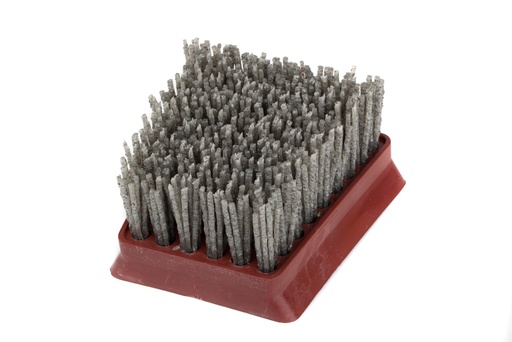
Fickert or Frankfurt? Start with the material
The first choice is not really about the brush — it is about the stone. Frankfurt is the standard format for marble and softer stone lines; Fickert is the format used on granite and hard-stone lines. Most automatic lines are built around one holder standard or the other, so the format you need is usually set by the machine you already own. If you process both materials, you will typically keep two sets of tooling.
Both formats do the same job — they remove a controlled amount of material and leave a textured, brushed or antiqued surface — but they are sized and mounted for different line types. Getting the format right is what lets the brush seat correctly and wear evenly.
Then choose the grain: diamond, carbide, ceramic or rubber
Diamond brushes are the most aggressive and the longest-lasting: the right choice for granite, quartz and hard engineered stone where you need real texture and durability across long runs. Start the line with diamond in the coarser grits — for example Diamond Fickert 90 mm, 140 mm and 170 mm on granite lines, or Diamond Frankfurt on marble.
Carbide (silicon carbide) brushes are the workhorses of the antique finish. The silicon-carbide filaments create that classic brushed, leathered look and are typically placed in the final positions of the line to even out the texture — see Carbide Fickert and Carbide Frankfurt. They are more economical than diamond and ideal for marble and calibrated finishing.
Ceramic brushes sit between the two: an aggressive ceramic grain for grinding and calibration with a high removal rate and long life, such as Frankfurt Ceramic — useful when you need to take material down before texturing.
Rubber brushes are the softest option. Our flexible Cepiflex Fickert and Cepiflex Frankfurt give a satin, soft-touch finish on stone, ceramic and engineered surfaces — the last, gentlest pass when you want a smooth antiqued feel rather than a coarse texture. (You may know this type as Gomflex or Airflex.)
Build the sequence, not just one brush
A brushed finish is never one tool — it is a grit sequence. On a typical granite brushing line you start coarse and work fine: 30 → 60 → 120 → 220 grit, then finish with a silicon-carbide 320 grit brush to even out the texture. The coarse diamond positions open up the surface, the middle grits refine it, and the final silicon-carbide pass gives the uniform, tactile antique finish customers recognise. Skipping steps is the commonest cause of an uneven or scratchy result. Use the same logic on marble with the Frankfurt format, biased toward carbide and rubber for a softer effect.
Do not forget the edges
Faces are only half the job. Profiled and rounded edges finished on edge-polishing machines such as Comandulli need their own compatible wheels to carry the antique or satin look right to the edge of the slab — for example our Edge Polishing Wheels 125 mm and 150 mm. Matching the edge finish to the face finish is what makes a piece look professionally made rather than merely processed.
Quick selection guide
Granite / hard engineered stone: Fickert format, diamond for the coarse and mid positions, silicon-carbide to finish. Marble / softer stone: Frankfurt format, carbide and ceramic, Cepiflex rubber for a satin final pass. Calibration / heavy removal: ceramic grain, coarse grit, early in the line. Softest satin touch: Cepiflex rubber as the last step. Edges: Comandulli-compatible wheels to match the face finish.
If you are not sure which sequence fits your line, send us your machine model and the material you run — we will map the exact brush set, position by position. See the full range at www.cepicat.com.
Cepicat — industrial brushes made in Barcelona since 2005.