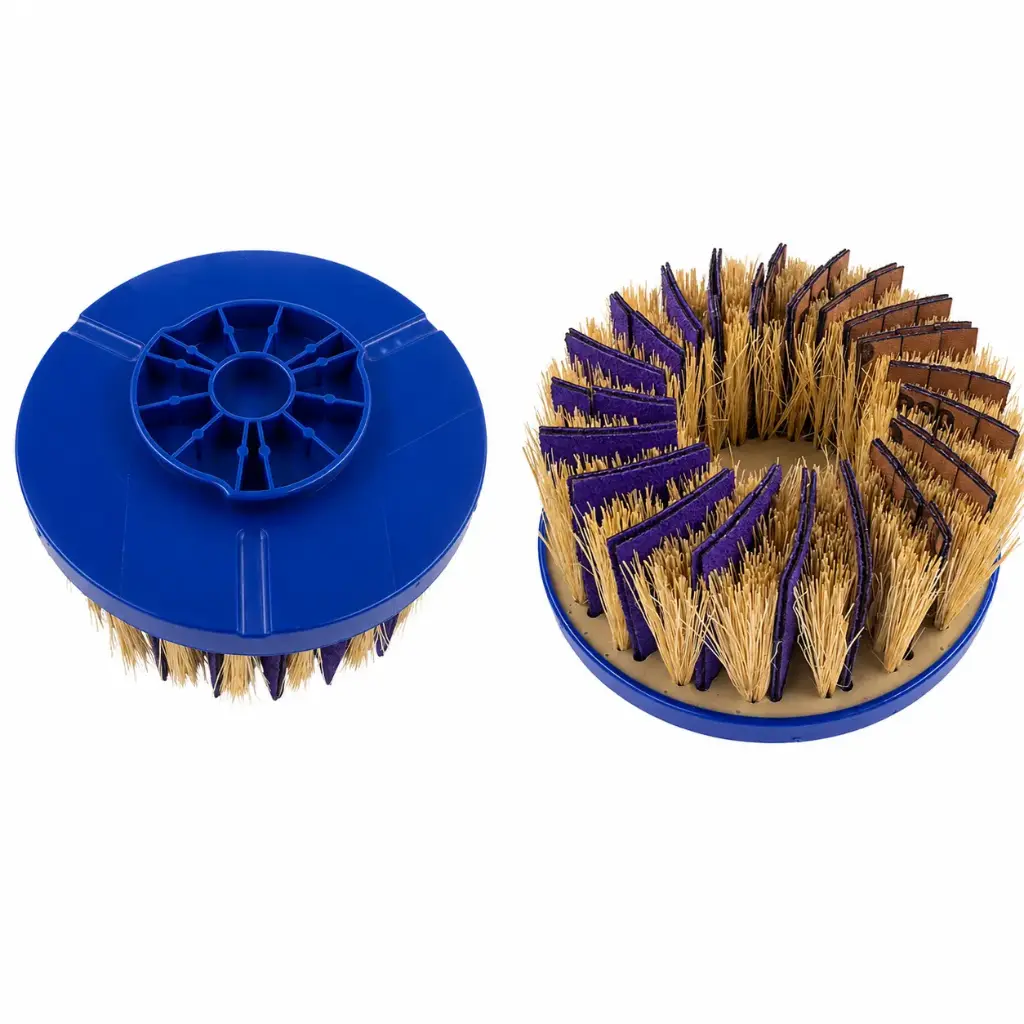
What they are
A tampico-backed flap brush combines two elements on the same rotating head: strips of abrasive cloth (aluminium oxide, zirconia or ceramic grain) and packs of natural tampico fibre placed directly behind each strip. The tampico acts as a flexible cushion: as the brush rotates, the fibre pushes the abrasive strip against the workpiece and lets it follow every contour, groove and edge.
Tampico is a natural fibre obtained from the Agave lechuguilla plant of northern Mexico. It is prized in surface finishing for a rare combination of properties: it is elastic and recovers its shape, it withstands heat and chemical exposure, it works perfectly dry, and unlike synthetic filaments it will not melt or smear at working temperature. Technical literature on wood finishing also credits tampico with helping to lift statically bonded dust from the surface — a welcome side effect between lacquer coats.
How the flexible backing changes the sanding action
With a rigid backing, contact pressure is concentrated wherever the surface is highest. With a tampico backing, pressure is distributed: the fibre compresses where the profile rises and extends where it falls, so the abrasive strip keeps near-constant contact pressure across the whole geometry. The practical results are a uniform scratch pattern on shaped surfaces, softened edges without rounding them out of tolerance, and no gouging — as the head rotates, fresh abrasive is constantly presented to the surface and wear stays even.
Typical applications
These brushes are the standard solution for sanding shaped and profiled parts (mouldings, door frames, furniture components), denibbing and satinising between lacquer coats, finishing brushed or rustic wood where the abrasive must reach into the open grain, and light edge breaking. They run on planetary and orbital brushing heads of finishing machines — Costa Levigatrici being a common example — as well as on simpler drum and spindle setups.
The parameters that matter
Four variables control the result. Grit: 80 for shaping and strong effects, 100–120 for intermediate sanding, 150 and finer for denibbing and satin finishing. Penetration depth: the brush should only kiss the surface — 1 to 3 mm of interference is usually enough; more pressure does not sand faster, it only wears the flaps. Speed: moderate, typically in the hundreds to low thousands of RPM; excessive speed stiffens the flaps and defeats the flexibility you bought the brush for. Direction: alternating rotation (left- and right-handed heads) avoids laying the fibres and gives a symmetrical finish.
The Dry Costa range
At Cepicat we manufacture tampico-backed flap brushes in our Dry Costa range: 80 mm and 125 mm diameters, left and right rotation, aluminium oxide, zirconia or ceramic abrasive, grits from 80 to 150, and four constructions (flap, scotch, high density and double scotch) to match the aggressiveness your process needs. All of them are made in our factory in Argentona, Barcelona, and can be adapted to your machine's fixation.
You can see the full range at www.cepicat.com under Dry. And if you want to test them on your own parts, write to us — we like sanding problems.
Cepicat — industrial brushes made in Barcelona since 2005.