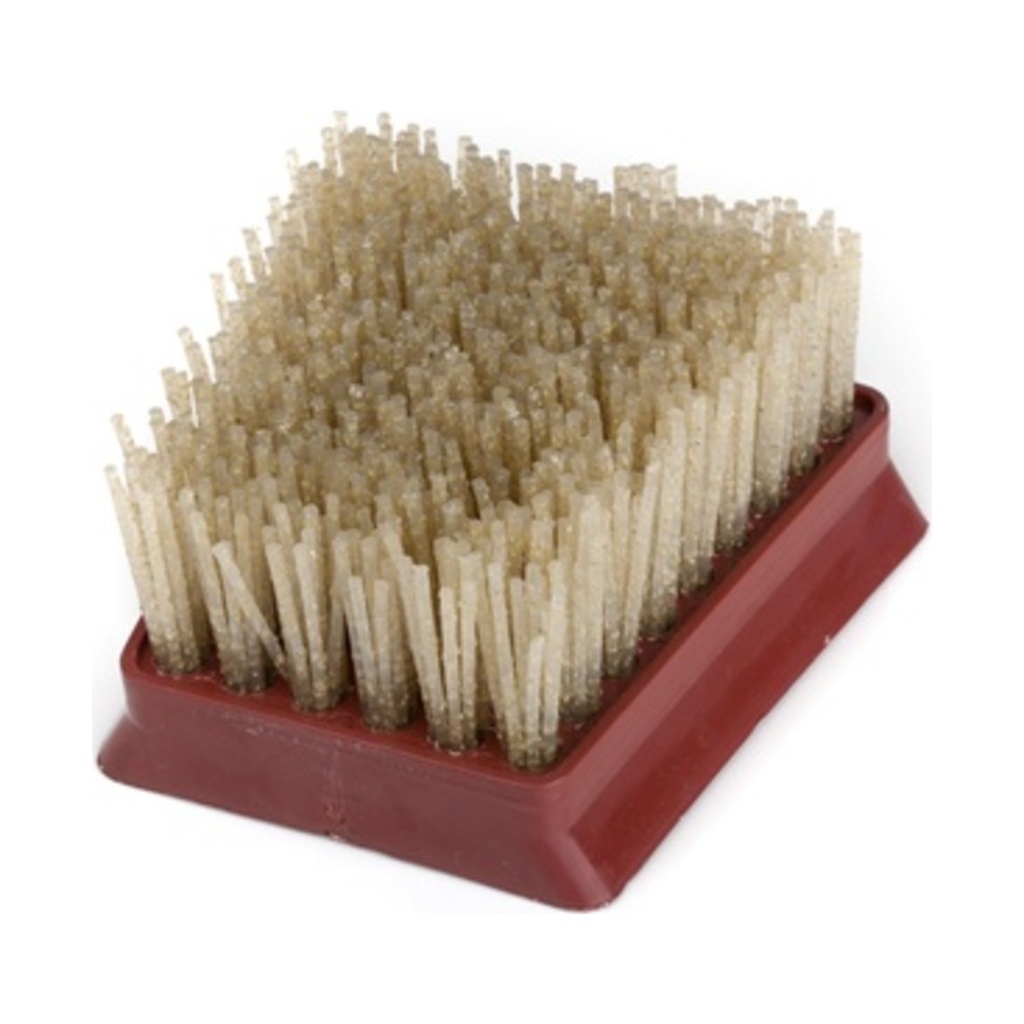
What a Frankfurt brush actually does
A Frankfurt-format brush replaces the rigid abrasive block on brushing and honing machines to create an aged, leathered, brushed or antique surface instead of a flat polish. The abrasive filaments follow the micro-relief of the stone, opening the surface and softening reflections. The two variables that decide the result are the abrasive material in the filament and the grit. Everything else — machine, format, head layout — stays the same, which is exactly why the diamond-versus-carbide decision is worth getting right.
Diamond vs carbide: what really changes
Both brushes share the Frankfurt body; the difference is the abrasive grain embedded in the bristle. Silicon carbide is hard and sharp but wears down as it cuts, so a carbide Frankfurt is aggressive at first and gentler as it ages — forgiving on soft stone, and inexpensive to replace. Diamond is far harder, holds its edge far longer, and keeps cutting on materials that would quickly round off a carbide grain. That extra life and hardness is what you pay for: a diamond Frankfurt costs several times more per piece, but on hard or abrasive stone it outlasts many carbide brushes and holds a more consistent finish across a production run.
When carbide Frankfurt is the right choice
Reach for the Carbide Frankfurt when you work marble, travertine, limestone and other softer natural stones, and when cost per piece is a real constraint. It is available across the full working range — from coarse grit 24 up to grit 800, resined or non-resined — which covers antiquing and brushed finishes on soft stone without over-investing in diamond you don't need. On a marble aging line, carbide is usually the sensible default; the stone is soft enough that diamond's extra life doesn't pay back.
When diamond Frankfurt earns its price
The Diamond Frankfurt is the choice for granite, quartz and engineered or sintered stone — the hard, abrasive materials that chew through silicon carbide. It runs from grit 24 all the way up to grit 3500, so beyond aging it can build a fine, bright, glossy finish that carbide simply can't reach. On these materials diamond also holds its cut far longer, which means fewer brush changes, less variation between the first slab and the hundredth, and lower downtime — the reasons it works out cheaper per square metre despite the higher sticker price. If you are chasing a silk or brilliant effect on engineered stone, this is the brush.
Grit and sequence, in practice
Whichever abrasive you pick, the finish is built in steps, not in one pass: start coarse enough to open the surface and create the relief, then climb through the grits to close it to the look you want. A typical antiquing sequence runs from a coarse grit through the mid range; for a brighter, more polished result on hard stone you continue up into the fine diamond grits (1000 and above). Don't skip too many steps between grits — each brush should remove the scratch pattern of the previous one. If in doubt, test the sequence on an offcut of the actual stone before committing a batch.
A simple rule of thumb
Match the abrasive to the stone's hardness and the finish to the grit: soft stone and tight budget → carbide; hard or engineered stone, long runs, or a bright finish → diamond. When a line runs mixed materials, many workshops keep both on hand and switch by job rather than compromising with one. For a broader view of when a Frankfurt beats a Fickert in the first place, see our guide on choosing antiquing brushes for granite and marble lines, our note on the Frankfurt brush for aging marble and synthetic stone, and what we mean by a silk finish on granite.
Not sure which fits your line?
Tell us the stone, the machine and the finish you are after, and we will point you to the right abrasive and grit sequence — or send a sample to test. Get in touch with our technical team.
CEPICAT — industrial brushes made in Barcelona since 2005.