How the fineblanking technique works
Fineblanking is a specialised stamping method that combines punching and cutting to produce parts with clean, near burr-free edges. Unlike conventional stamping, it uses a triple-action tool — a punch, a die and a counter-punch — that clamps and compresses the metal before it is cut, so the material is sheared rather than torn. The process runs in three main stages:
- Blanking: a metal strip is fed into the press, where the clamped punch and die shear the blank with a smooth, full-thickness edge instead of the fractured edge left by ordinary stamping.
- Piercing: holes and internal features are punched while the die set holds the part firmly, keeping every feature in precise register.
- Cutting: the finished part is sheared from the strip with a clean cut that needs minimal further work.
Advantages of fineblanking
Fineblanking offers several advantages over other metalworking processes:
- High precision: parts with extremely tight tolerances.
- Clean edges: smooth, square faces that reduce or eliminate secondary deburring.
- High-volume production: fast, repeatable mass production.
- Material savings: less waste than many competing forming methods.
Applications of fineblanking
It is used wherever precision flat parts are needed in volume:
- Gears and sprockets: high-precision transmission components.
- Brackets and connectors: for automotive and aerospace assemblies.
- Surgical instruments: scissors, forceps and tweezers needing exact shapes.
- Electrical contacts: switches and relays requiring smooth, accurate features.
Deburring the fine-blanked edge
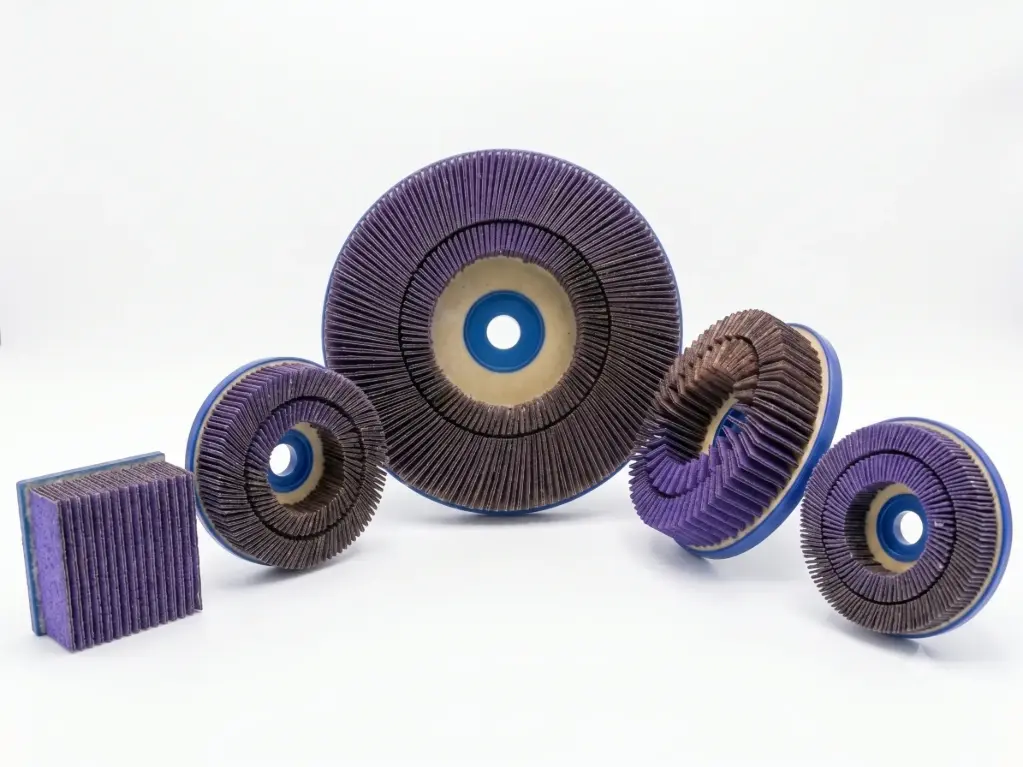
Even with the clean, sheared face that fineblanking produces, the part still leaves the die with a die-roll on one side and a small burr on the other. For gears, sprockets and precision components that go on to be coated, assembled or handled, that edge has to be deburred and lightly rounded. Doing it by hand does not scale; in production it is done with abrasive brushes that follow the contour and break the edge without touching the flat face. We explain how to choose between manual and machine deburring in how to remove metal burrs, and the brush options in the FLAP brush for metal deburring and our guide to abrasive brush deburring.
Fineblanking and Cepicat
Cepicat supplies deburring and edge-rounding brushes for fine-blanked and stamped parts under the CEPIMET line, matched to your part and your machine. Deburring fine-blanked parts in volume? Send us a part and we will propose the brush and grit, made to fit your equipment. See the range in the shop.
CEPICAT — industrial brushes made in Barcelona since 2005.