What a burr is, and why it matters
During any machining or cutting operation the tool pushes material past the edge instead of cleanly severing it. That displaced metal solidifies as a burr on the exit side of the cut. It looks minor and it is not: a sharp edge is a safety hazard on the shop floor, it is the first place corrosion starts because paint and powder pull away from it, and it changes the real dimension of the part. Removing the burr — and, better still, rounding the edge slightly — solves all three at once.
Removing burrs by hand
For a single part or a small repair, hand work is enough. Inspect the part and make sure it is clean and free of oil. Take down the burr with a coarse abrasive — sandpaper in the 40 to 80 grit range, or a file — working flat against the surface with firm, even pressure so you do not scratch the face. Then refine with a finer grit, 100 to 200, until the edge is smooth to the touch. For curved or hard-to-reach areas use a small abrasive disc on a rotary tool, working carefully. Clean the part with a dry cloth when you finish, and wear gloves throughout — a fresh burr is sharp.
Hand deburring is fine for the occasional part. What it is not is repeatable or fast: the result depends on the operator, and it does not scale to production. The moment you have batches of parts, the tool changes.
Deburring in production: abrasive brushes
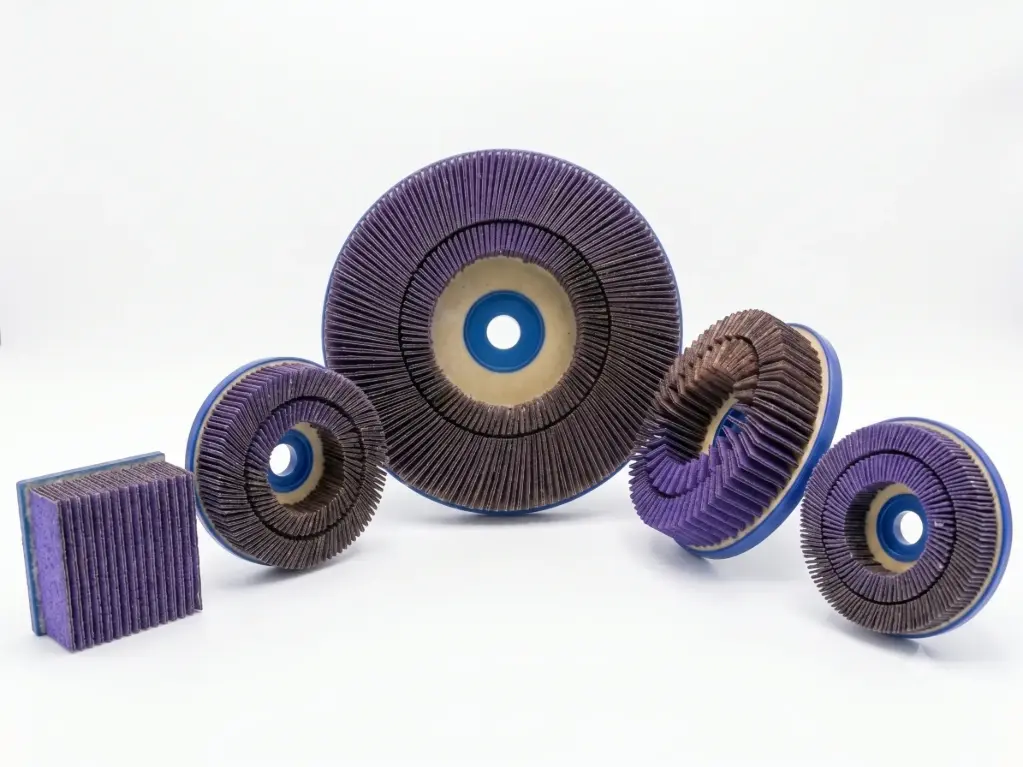
For any real volume, the industrial method is an abrasive brush on a deburring machine. Abrasive-filament and abrasive-flap brushes pull across the edge as they rotate, removing the burr consistently on every part and, critically, leaving a uniform rounded edge instead of a raw one. Unlike a grinding belt, a brush follows the contour of the part — inside holes, along internal cut-outs and around complex profiles — without altering the flat geometry.
Which brush depends on the burr:
Light to medium burrs and a fine finish. A flexible abrasive brush removes the burr and leaves a clean surface in a single pass. We cover the workhorse of this category in the FLAP brush for metal deburring.
Heavy burrs and a real edge radius. When the part goes to powder coating and needs a measurable rounded edge, you need a high-density abrasive brush that removes more material while still flexing around the edge — see HD and HD PRO high-density discs. For the specific goal of a 2 mm radius running dry, we set out the parameters in edge rounding on laser-cut parts.
Laser or plasma dross. The hard slag left on the underside of a thermal cut is not abrasive work — it is knocked off first with steel pins, then the edge is deburred. See slag removal pins.
If you want the full picture of how brush deburring compares with other methods for machined and laser-cut parts, we go into it in our guide to abrasive brush deburring.
Which route is right for you
One-off part or a repair: sandpaper and a file. A batch of parts, a coating spec to meet, or a burr you are removing again and again: a brush on a machine, chosen for your burr type and the radius your customer requires. The second route is faster per part, repeatable, and it rounds the edge as it deburrs — which is what actually protects the coating and the operator.
Tell us the part, the material and thickness, how you cut it, and the machine you run. We will propose the brush and grit and make it to fit your holders. See the range in the shop or send us your part — we run samples.
CEPICAT — industrial brushes made in Barcelona since 2005.