Why quartz behaves differently
Engineered quartz is roughly 90–93% mineral aggregate held together by a polyester resin. That resin is the whole problem. It softens with heat, it burnishes under pressure, and it does not wear at the same rate as the quartz grains around it. Push a hard tool too fast and you get three failures at once: a glossy smear where the resin has melted and flowed, a chalky halo where it has been torn, and a texture that changes depth from the middle of the slab to the edges.
Granite forgives all of this. Quartz does not. The rule of thumb is lower pressure, generous water, and a tool that flexes rather than one that cuts hard — which is exactly the reasoning behind splitting the job between two very different brushes.
The two stages, and why both are needed
A leather finish is a shallow, even, orange-peel-like relief. Getting there means creating the relief first, then softening it. One tool cannot do both well.
Cepibrush Diamond Fickert opens the texture. Diamond segments on a flexible filament carrier remove the polished skin and cut the relief into the surface. Coarse grit for a pronounced, deeply structured leather; finer grit where the customer wants something closer to a soft touch or suede. This is the stage that decides the character of the finish, and it is where the aggressiveness lives.
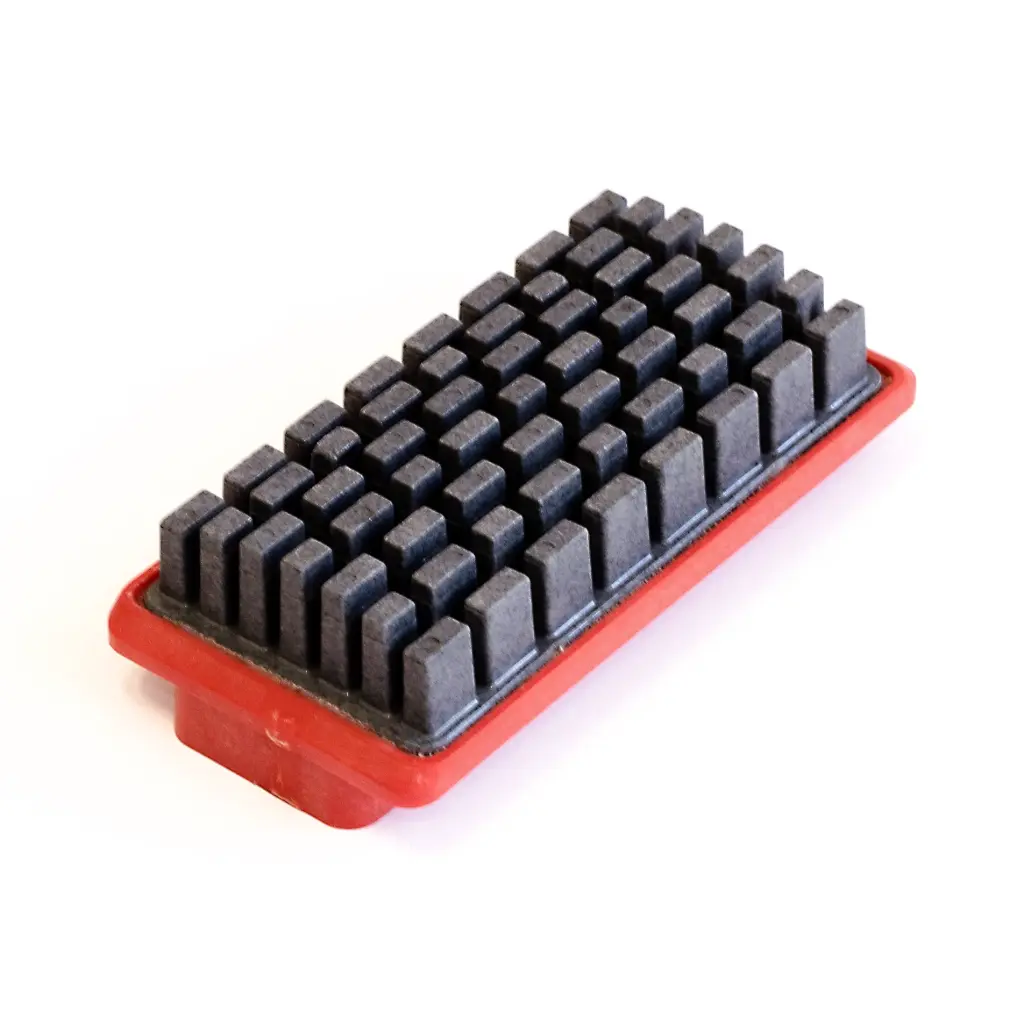
Cepiflex closes it. These are rubber-bonded Fickert brushes: the abrasive sits in an elastomer body that flexes under load, so the tool follows the relief the diamond has just created instead of flattening it. It rounds the peaks, removes the scratch pattern and leaves the characteristic soft, silky hand feel — without generating the heat that would gloss the resin.
Skip the Cepiflex stage and the slab feels rough and looks scratched. Skip the diamond stage and there is no relief to soften: you get a matt slab, not a leather one.
Cepiflex: the rubber-bonded range
Our Cepiflex Fickert L=140 is made in the standard Fickert format, so it drops straight into any line already running Fickert holders. Two families matter here:
Matt Soft, colour-coded by grit so the operator can identify them across the line at a glance: grit 120 grey, 220 green, 300 brown, 400 blue, 600 black, 800 walnut. This is the working range for leather and suede finishes.
Lux, from grit 100 up to 6000, for when the customer wants the leather relief but with more sheen at the top of the surface — a satin leather rather than a fully matt one.
Both are available on the "SL2" and "SL6" plastic bases, and we also make the rectangular and "BIG" formats for lines that need more contact area per head. If you already run our brushes for other finishes, the logic is the same one we described in Cepiflex for satin finish surfaces.
Laying it out on a Breton line: 18 + 8 heads
On a Breton line with eighteen main heads plus eight satellites, the split we see working most often is this: the diamond Fickert occupies the first block of heads, the Cepiflex occupies the last, and the satellites carry the finishing grits.
The first heads do the structural work — removing the factory polish and cutting the relief — starting coarse and stepping up. Somewhere around the middle of the line the character of the finish is already fixed; nothing after that point will make the texture deeper, only smoother. From there the Cepiflex Matt Soft brushes take over, stepping through the grits so that each head removes the marks of the previous one without flattening the relief.
Two things matter more than the exact sequence. First, do not jump grits: every step you skip shows up as a scratch pattern that the next head cannot remove, and you will see it under raking light even when the slab looks fine on the bench. Second, keep the pressure low and even across the beam. Uneven pressure on quartz does not just change the gloss, it changes the depth of the leather, and a slab with a deeper texture down one side is scrap.
The same reasoning applies to other engineered surfaces — we covered the equivalent problem on sintered stone in Dekton texturing techniques.
Fickert or Frankfurt?
For quartz slab lines, Fickert. The format is standard across Breton, Simec, Pedrini and comparable machines, the contact area suits large flat slabs, and the tooling is straightforward to swap. Frankfurt has its place on marble lines and on some older equipment — we set out the difference in Fickert vs Frankfurt brushes.
What we need from you to specify it
There is no universal recipe, and anyone offering one has not run enough quartz. The sequence depends on the resin content of your material, the line speed you need to hold, the number of heads you can dedicate, and how deep the customer wants the leather. Tell us the machine and head count, the quartz brand you process, and send us a sample of the finish you are trying to match — we will propose the grit sequence and make the brushes to fit your holders.
See the range in the shop, or write to us with your slab. We run samples.
CEPICAT — industrial brushes made in Barcelona since 2005.