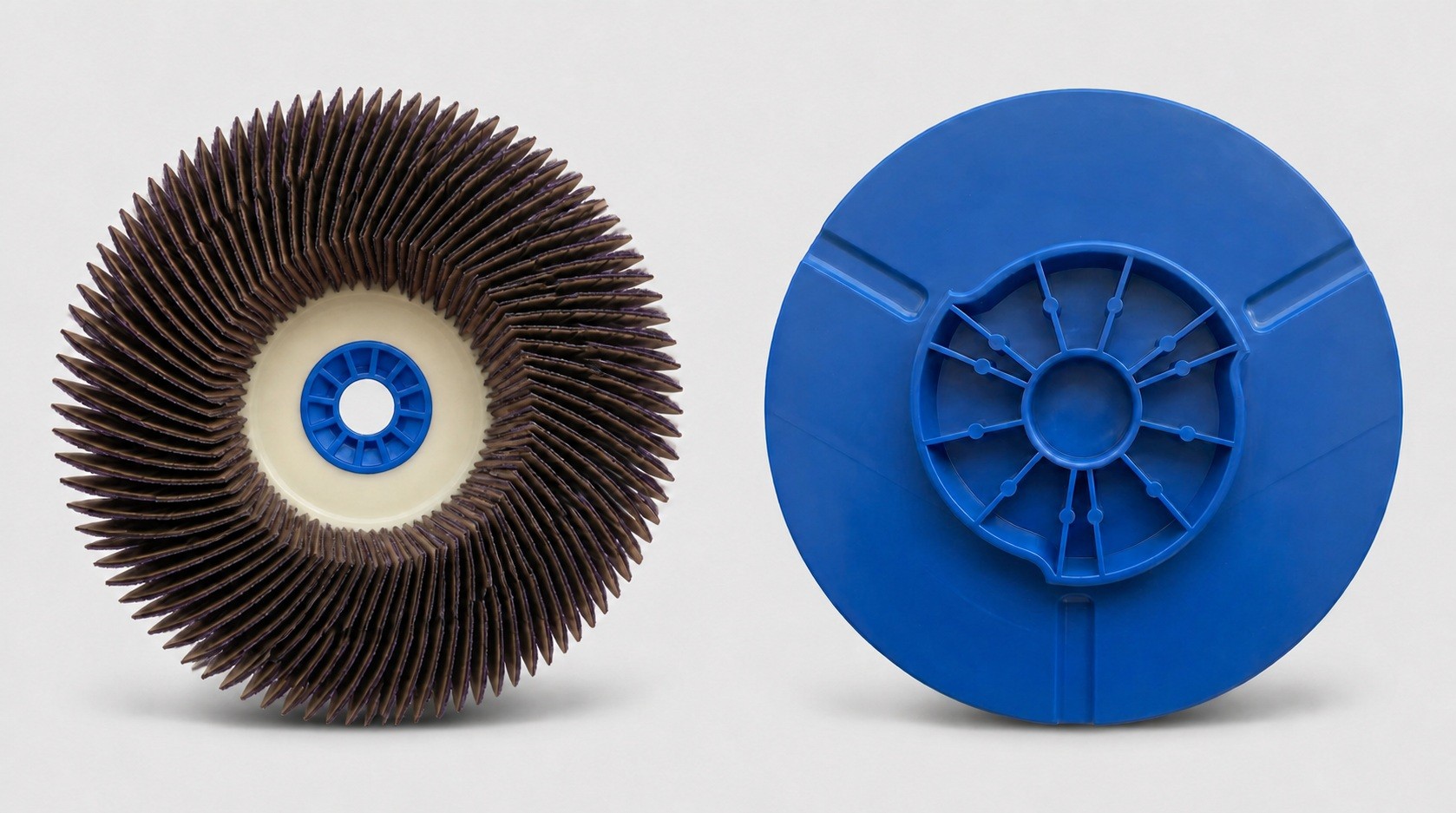
What the Costa mount actually is
Because the hub is standardised, you are not locked into OEM pricing or lead times: any 125 mm disc built to the Costa mount — ours included — drops straight onto the existing hub. If your line instead runs a Timesavers-pattern head, the holder is different; we cover that mounting in HD and HD PRO: high-density deburring discs.
Four brush types, one holder — only one rounds the edge
On the Costa 125 mm holder you can select: Flap (Tampico), Scotch, High Density (HD) and Double Scotch. They are not interchangeable for the same job.
- HD is a high-density abrasive-flap disc, radially slit so the block keeps many cutting points at the edge while still flexing into contours and holes. It is the tool that removes dross, strips the oxide skin left by laser or plasma cutting, and puts a measurable radius on the part.
- Scotch (non-woven) does not cut — it conforms to the surface and removes the fine scratch pattern the HD stage leaves, giving the uniform satin finish customers judge the part by.
- Flap (Tampico) and Double Scotch sit between the two, useful for lighter stock removal or an intermediate finishing pass depending on material and thickness.
We go through the HD-versus-Scotch logic in more depth, including how to sequence two or three heads, in when to use HD brushes and when to use Scotch.
How much radius you actually need
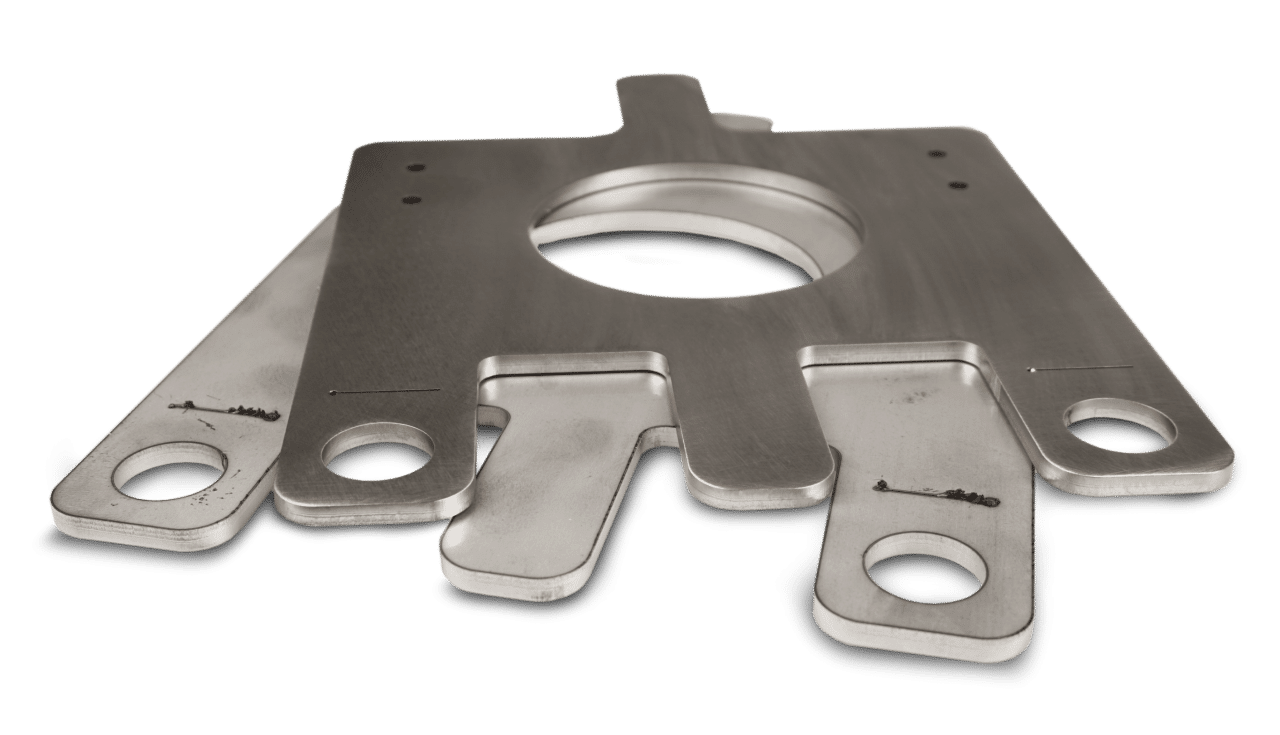
Work from your customer's specification rather than a rule of thumb, but as a guide: about R0.2 mm covers cosmetic deburring and safe handling, R0.5 mm is the usual minimum for reliable powder-coating adhesion, and R2 mm applies where higher corrosion-protection categories are specified. A coarser grit on the HD disc removes more stock per pass and gets you to the larger radius faster; a finer grit leaves less to clean up on the Scotch stage. We measured the parameters for reaching a 2 mm radius running dry in edge rounding on laser-cut metal parts.
Material and grit: what is in stock for the 125 mm Costa disc
The 125 mm Costa holder is available in oxide, ceramic and zirconia abrasive, in 80, 100 and 120 grit, across all four brush types. Ceramic is the one to reach for on stainless and other work-hardening alloys where oxide would glaze quickly; zirconia is the general-purpose choice for carbon steel and aluminium. Other diameters, grits and mountings — including 12 mm shank for robot cells and M14 for hand-held angle grinders — are made to order.
Send us the part and the machine
The right brush type, grit and material depend on your material, thickness, whether you cut with oxygen or nitrogen, and the radius your customer specifies. Tell us the part and the machine model — Costa MD, MD4, MD5, WD, MP or equivalent — and we will propose the setup and grit sequence, and make the discs to fit your hub. See the range in the shop or write to us. We run samples.
CEPICAT — industrial brushes made in Barcelona since 2005.