Why a rigid disc fights the part instead of following it
An HD (high-density) or scotch disc holds its abrasive segments essentially rigid, which is exactly what lets it put a measurable, consistent radius on a straight edge — see our note on reaching a 2 mm radius in dry mode. That same rigidity becomes a liability the moment the geometry changes: the disc cannot compress into a hole or a slot, so it either misses the burr entirely or, if it is pressed harder to compensate, digs into the surrounding flat and leaves a visible halo. On parts with variable stack height — common straight off a press — a rigid disc also transmits every height variation straight into the part as inconsistent stock removal.
What a tampico flap disc actually is
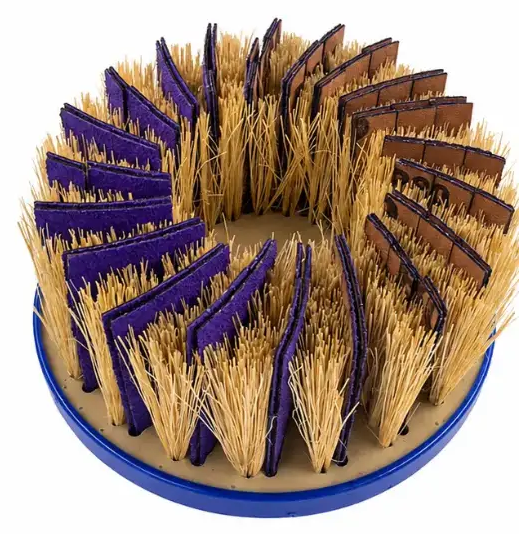
A tampico flap disc alternates two elements around the same head: short segments of abrasive flap (the cutting element) and packs of natural tampico fibre in between. Tampico — a natural fibre from the Agave lechuguilla plant — is elastic, heat-resistant and does not glaze or melt at working temperature. Because the fibre compresses independently around each flap segment, the whole face of the disc follows the part instead of pressing against it as a single rigid block: contact pressure evens out across holes, slots and stack-height variation instead of concentrating on the highest point. We cover the fibre itself and its sanding applications in more depth in tampico-backed flap brushes for flexible sanding; here we are looking specifically at what that flexibility does for edge deburring on a production line.
Q-Fin TopGrinder and ProGrinder: two heads, M14 mount
Q-Fin's FLEX-Line semi-automatic machines — TopGrinder and ProGrinder — run two independent grinding heads on an M12/M14 spindle mount, so an operator can put a coarse disc on one head and a finishing disc on the other and switch between them in seconds. TopGrinder handles sheet up to 780 mm wide and 120 mm tall in a single pass, dry by default with an optional WES3000 wet extraction stage. Because the mount is a standard threaded shaft rather than a proprietary hub, a tampico flap disc built for it is a made-to-order fit rather than a stock catalogue item — tell us the head diameter and maximum disc height and we build to it.
Weber PT, NLC, TTSC and the Multi-Rotation Brush system
Hans Weber's grinding series (PT, PT compact, NLC, NLCA, TTSC, TTK, TNA and others) run cup and round brushes on a Multi-Rotation Brush head that Weber itself documents as open to tooling from other manufacturers — which is the arrangement we already supply under. Our 125 mm tampico flap disc for the Weber DX mount is in stock in ceramic, zirconia and oxide, grit 60 to 80, and ships as a direct swap onto the existing head.
Material and grit: what's in stock
The 125 mm disc for the Costa-type 127 mm hub — the same construction we build for Weber's DX mount — is available in oxide, ceramic and zirconia, grit 80 to 150, as the Flap (Tampico) option alongside Scotch, High Density and Double Scotch on the same holder. See the 125 mm Flap (Tampico) configuration in the shop. Ceramic holds up best on stainless and other work-hardening alloys; zirconia is the general-purpose choice for carbon steel and aluminium.
Send us the part and the machine
Tell us your machine — Q-Fin TopGrinder or ProGrinder, Weber PT/NLC/TTSC or another Multi-Rotation Brush line, Costa MD/WD/MP — plus the part geometry and material, and we will propose the disc construction and grit sequence, sized to your mount. See the range in the shop or write to us. We run samples.
CEPICAT — industrial brushes made in Barcelona since 2005.